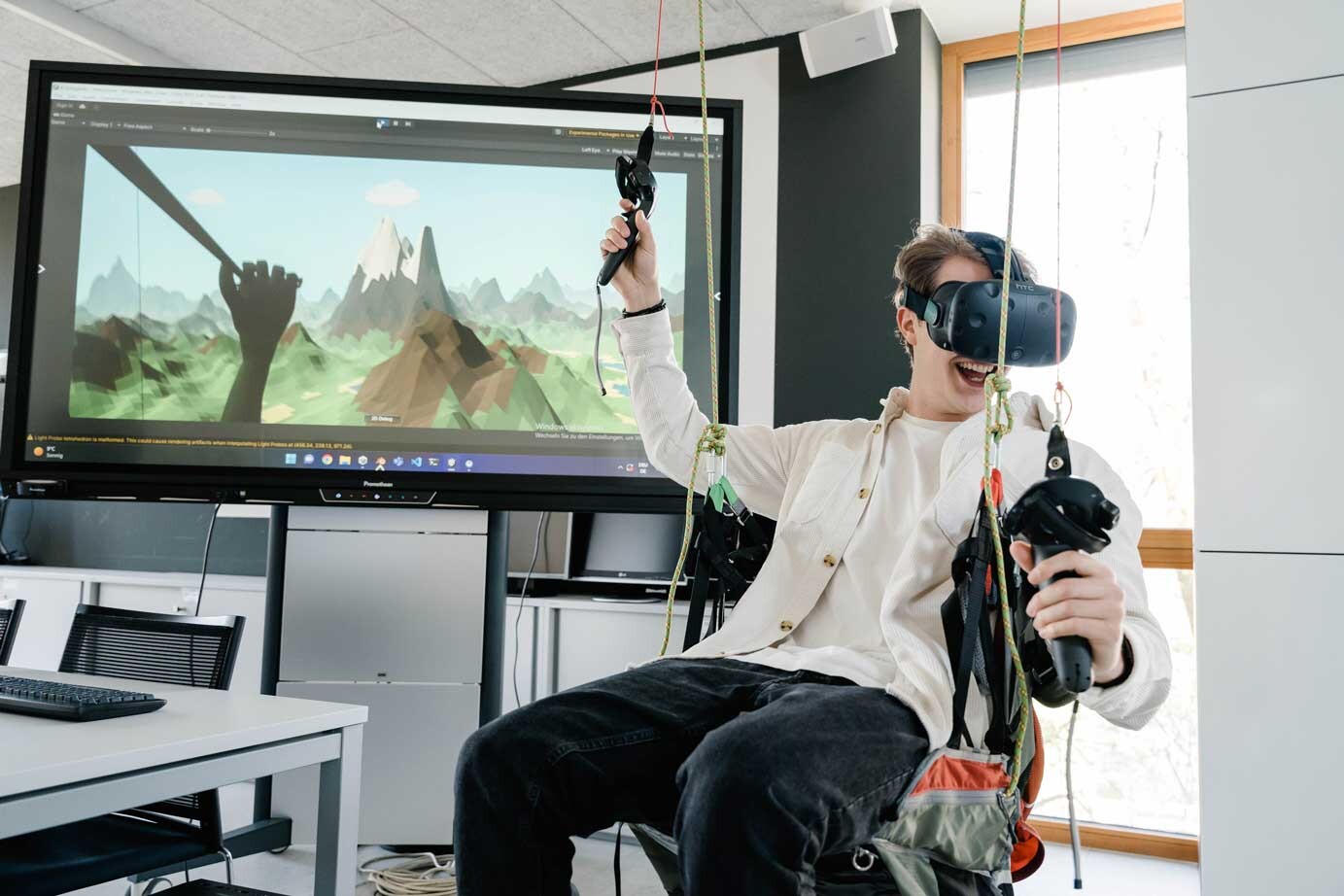
Our full-time bachelor’s degree program emphasizes software development for web and mobile platforms, along with cloud computing and software engineering. You will learn design principles and work with modern tools to bring your own app ideas to life. Step into the world of digital innovation and become a creator!

Coding & Digital Design
Bachelor's degree program
Overview
-
Qualification Level:
Stufe 1, Bachelor -
Price:
Euro 363,36* (excl. Student Union-fees) each semester -
Academic Degree:
Bachelor of Science in Engineering (BSc) -
Academic Program:
Full-time -
Language:
60 % German, 40 % English -
Remote Options:
E-Learning max. 30 % online -
Exchange Semester:
Organized stay abroad, 5th semester, internship in the 6th semester (also possible abroad)** -
Admission Requirements:
General admission requirements -
Study Places per Year:
30
Study program accredited by the Agency for Quality Assurance and Accreditation Austria

Program Description


Explore the Coding & Digital Design degree program, where you will master both software development and design. We focus on giving you a comprehensive understanding of digital applications - from concept to completion. Our aim is to equip you with the skills to turn your creative app ideas into reality.
The Coding & Digital Design degree program offers expertise in both software development and design, providing a well-rounded understanding of digital applications. Students gain the skills needed to independently develop and creatively design their own projects. The curriculum covers software development, web and mobile applications, and key topics such as cloud computing, software engineering, and front-end and back-end development. In the design component, students use modern tools to create media content and bring their own ideas to life.
Study Focus
-
25 %
Software development
-
25 %
Design
-
25 %
Transfer of practical experience
-
25 %
Complementary contents
What You Will Learn
-
Developing web applications
-
Developing mobile apps
-
Basics of digital design
-
Modern design tools
-
Creative software design
-
Digital product planning and marketing
Popular Occupational Fields
- Software development for web and mobile
- Software and application design
- Project management for digital products
- IT consulting
- IT service
- Self-employed entrepreneurial activity
Career Opportunities
-
430+ vacancies
in IT and data analysis in Tyrol
-
EUR 50,200 average salary
for employees in the IT/data analysis sector in Austria in 2022 (according to WeAreDevelopers)
-
EUR 30.8 billion budget
for investments in IT and data processing in Austria in 2021 (according to Statista); still growing
-
+27.48 % revenue growth
in the IT services market in Austria between 2024 and 2028
-
+3,7 % growth
in the European IT and data sector (according to Gartner 2023); trend continues
The path to the Bachelor's Degree

The degree program spans six semesters. In the first two semesters, students build a foundation in coding and design, which is further developed during the 3rd and 4th semesters. The 5th semester is dedicated to studying abroad, allowing students to broaden their knowledge in an international setting. In the 6th semester, students complete an internship and work on their bachelor’s thesis.
Special features:
-
Practical knowledge transfer from day one
-
Integrated semester abroad in 5th semester
-
Integrated internship in 6th semester for optimal career start
Recognition of Prior Learning
Students have the option to receive credit for skills and competencies they have already acquired before the start of each semester.
To apply for credit, they must submit a request directly to the Director of Studies.
Director of Studies

Dr. Benjamin Schwendinger
Director of Studies Bachelor Coding & Digital Design | Master AI Systems Engineering, Data Science & Intelligent Analytics
Curriculum
Course
Semester
ECTS
- Fundamentals of database systems and data management
- Data modeling (single entity, attributes, cardinality, conditionality, relationship types)
- Candidate keys, superkeys, and primary keys
- Normalization of data structures (at least 1, 2, 3)
- Interaction with relational databases using SQL in the areas of DDL, DML, and DQL
- Basic database management activities on advanced database concepts in the area of NoSQL
- Propositional logic and logical operators, predicate logic, arithmetic laws of propositional and predicate logic
- Set theory: basic concepts, set operators, calculation rules for sets
- Relations: basic concepts, properties of relations, equivalence and order relations
- Number concepts: sets of numbers, summation and product notation, positional numeral systems, binary and hexadecimal systems
- Sequences: concept of sequences, essential properties, convergence, O-notation
- Modular arithmetic: concept and calculation rules, applications
Course
Semester
ECTS
A generally valid module description for the semester abroad cannot and should not be defined due to the large number of partner universities and the choices offered there within the information technology-oriented sciences (computer science, business informatics, information management, and related disciplines) in order to ensure freedom for students.
The national credits are converted individually into ECTS points in accordance with the achievements demonstrated. The students are subject to the respective examination modalities at the partner university.
A generally valid module description for the semester abroad cannot and should not be defined due to the large number of partner universities and the options offered there within the design-oriented sciences in order to ensure freedom for students. The content of teaching is based on the fundamentals and specializations of the individual disciplines in the economic subject areas of the degree program. The national credits are converted individually into ECTS points in accordance with the achievements demonstrated. Students are subject to the respective examination modalities at the partner university.
A generally valid module description for the semester abroad cannot and should not be defined due to the large number of partner universities and the choices offered there within the economically oriented sciences in order to ensure freedom for the students. The content of teaching is based on the fundamentals and specializations of the individual disciplines in the economic subject areas of the degree program. The national credits are converted individually into ECTS points in accordance with the achievements demonstrated. Students are subject to the respective examination modalities at the partner university.
Course
Semester
ECTS
This introductory course addresses the technological foundations of the web and the key implementation technologies used in this context (HTML, CSS). Students are introduced to the complete development process of a web application (design, wireframing, implementation, testing, operation, and maintenance), with particular attention to the interface between web design and web programming. Emphasis is placed on widely used web technologies, including the HTTP protocol for client–server communication and HTML and CSS as the primary tools for client-side presentation. The course covers the fundamentals of Internet programming; page encoding with the markup language HTML; basic formatting, tables, and forms; and CSS fundamentals (structure of CSS files, selectors, basic formatting options, dynamic presentation effects).
Students also learn how to create appealing websites and web applications. In addition to technological standards, the course includes foundational knowledge in layout and perception, typography (readability and typefaces), and color theory (color schemes and color effects). This course provides a solid foundation for students to further develop and successfully apply their skills in web design and product development.
Editing and design fundamentals in Adobe, for example:
- General program functions and workspaces
- Drawing tools
- Layer techniques
- Selection functions
- Cropping tools
- Colors and formatting
- Objects
- Image editing
- Compositing
- Texture/patterns/artboards
- Distortion effects
- Backgrounds
- Text editing
- Template creation
- Rulers, guides, grids
- Import/export/vectorization
- Wireframing and working with wireframing technologies
- Mockup design and implementation using Photoshop, Illustrator, or XD
- Icon and pictogram design: dos and don'ts
- Basic principles of modeling, material creation, lighting, animation, and rendering of virtual scenes
- Mapping of transformations, local and global coordinate systems, as well as definition and control of the virtual camera
- Overview of essential modeling tools and modifiers (e.g., included in Maya included in Maya, 3D Studio Max, and Blender)
- Modeling of polygonal meshes and using parametric curves and surfaces (splines, NURBS)
- Common light source types and lighting models, as well as the creation of realistic shadows for real-time applications
- Material definition and physical effects such as reflection, refraction, translucency, and dispersion
- Texturing of models, UV mapping, and procedural textures
- Overview of advanced material and lighting techniques such as IES, HDRI, IBL, and skydomes
- Keyframe animation, interpolation of transformations, gimbal lock, and path animation
- Creation of animation sequences with animation curves and actions
- Animation of characters using cinematic models (rigging, skinning)
Students learn to assess the benefits of websites and web applications based on usability criteria. This section also includes methods for usability evaluation and covers the basics of technical and content-related usability.
Course
Semester
ECTS
- Practical examples that are processed with the support of modern project management software (e.g., Gitlab)
- Project planning: issues, issues board, milestone tracking
- Project controlling: work breakdown structures and other performance, resource, and cost planning tools
- Process models: using SCRUM as an example
- Documentation: IT-supported documentation with modern project management tools (e.g. Gitlab)
- Models and methods for stress and resource analysis (work-life balance)
- Mechanisms of gender roles, bias and structural disadvantage, as well as practical approaches for gender-inclusive design of work and learning environments
Course
Semester
ECTS
Business Administration:
- Entrepreneurial Fundamentals: Discussion of business-related topics such as legal forms, purchase contracts and regulations, and commercial registers
- Financing Methods: Introduction to equity financing, restructuring financing, debt financing, and modern financing methods
- Business Plan Development: Business plan development, including financial planning
- Strategic Management: Planning and analysis in strategic management
- Investment Calculation Methods: Calculation techniques for static and dynamic investment
Economics:
- Economic fundamentals: Introduction to the basics of economics
- Market theory and price theory: Exploring market dynamics and pricing
- Microeconomics, Macroeconomics, Network Economics: Foundational concepts in microeconomics, macroeconomics, network economics
- Economic Indicators: Exploration of economic indicators like GDP, HDI, inflation, deflation, and stagflation
Financing:
- Fundamentals of Accounting: Introduction to the basics of accounting
- Cash Accounting: Exploration of cash-based accounting methods
- Cost Accounting Areas: Introduction of different areas within cost accounting, including cost concepts in decision making, cost classification and allocation, COGS, overhead application, conversion cost, and total cost formula
- Cost Accounting for Pricing: Overview of procurement, differential, and sales calculations, as well as actual cost accounting
- Introduction to Web Business: basics of online business, e-commerce models, online marketplaces and platforms
- Website development and design: creating engaging and user-friendly websites, website hosting and maintenance - E-commerce strategies: e-commerce business models, payment processing, security and Data protection
- Web analytics and tracking: Using tools such as Google Analytics to measure and analyze website traffic and conversions
- Conversion optimization: technologies to increase conversion rates, A/B testing, and user experience optimization
- Data-Driven Decision Making: web analytics supported business decisions in web business
- Fundamentals of online marketing
- Content strategy: planning and creating content for websites and social media, storytelling and branding
- Trends in web business and web marketing: current news and future trends in the digital space, including AI, chatbots, and voice search
Course
Semester
ECTS
The main aim of the introductory course on scientific work is to familiarize students with the special features, rules, and basic principles of science and scientific work. The focus here is on learning and understanding deductive and inductive methods and the empirical procedures for gaining knowledge.
Students are prepared to write seminar papers independently and in accordance with the usual standards of scientific work. This preparation includes a focus on dealing with literature as well as discussions regarding the quality of academ-ic co-workers - the concepts of intellectual honesty and intersubjective comprehensibility are of particular importance here.
The students report regularly on the progress of their bachelor's thesis during the working process in consultation with the supervisor. In seminar form, they present their current work status in small groups in the form of short presenta-tions and discuss the results of their work in the group. The students receive instructions and templates for writing the bachelor's thesis and, thus, appropriate accompanying academic supervision.
In this course, students write their final bachelor's thesis. They are individually supervised by a lecturer with regard to individual questions.
Within a given period of time, students are required to scientifically address an issue relevant to their studies and training as part of a bachelor's thesis. The topic should be worked on and discussed independently using scientific methods.
The bachelor's thesis can be written with a practical reference from the internship and thus deal with a current and concrete problem scientifically and practically.
Course
Semester
ECTS
In this course, students independently write their bachelor's thesis. Students work independently on a clearly defined question using appropriate scientific methods, systematically evaluate the findings, and document the results in the form of a scientific paper in accordance with the formal and content-related standards of the degree program.
Supplementing the students' theoretical knowledge with practical activities and business law issues in practice. At least 500 hours of full-time employment at an external company (12.5 weeks, i.e., approximately three months with an assumed working week of 40 hours/week).
The work placement ensures that students find their feet when entering the world of work and gain confidence in applying the knowledge they have acquired through the experience they have already gained. Processes, workflows, and situations in the professional environment should be familiarized with and understood.
Support for students during their work placement: reflection, discussion of problems, and experience reports.
Course
Semester
ECTS
Teaching basic concepts of private law based on the requirements of professional IT practice, in particular by presenting practical legal cases and jointly developing the legal principles required to solve the respective problems.
The following areas are covered in detail:
- Differentiation between public law and private law
- Company law
- General contract law
- Legal capacity and capacity to act of natural and legal persons and their legal consequences
- Explanations of terms from the most important areas of law
- Relationships between areas of law and IT practice
Course
Semester
ECTS
A1 – Beginner
Understand and use familiar, everyday expressions and very simple sentences aimed at satisfying concrete needs. Introduce themselves and others, ask people questions about personal details – e.g., where they live, the people they know, or the things they have – and respond to such questions. Communicate in a simple way if the conversation partners speak slowly and clearly and are prepared to help.
A2 – Elementary Knowledge
Understand sentences and frequently used expressions related to areas of most immediate relevance (e.g., personal and family information, shopping, work, local environment). Communicate in simple and routine tasks requiring a simple and direct exchange of information on familiar and routine matters. Describe in simple terms their background, education, immediate environment, and matters in areas of immediate need.
B1 – Intermediate Language Use
Use clear standard language in academic and business contexts and communicate about familiar topics related to work, school, leisure, etc., applying relevant conversational skills. Express themselves simply and coherently on familiar topics and areas of personal interest. Report on experiences and events, describe dreams, hopes, and ambitions, and briefly give reasons and explanations for opinions and plans.
B2 – Independent Language Use
Express themselves on the main ideas of complex texts on both concrete and abstract topics in academic and business contexts and participate in technical discussions in their own field of specialization. Communicate with such a degree of fluency and spontaneity that normal conversation with native speakers is quite possible without strain for either party. Express themselves clearly and in detail on a wide range of subjects, explain a viewpoint on a topical issue, and outline the advantages and disadvantages of various options.
C1 – Advanced Language Proficiency
Understand a wide range of demanding, longer texts and recognize implicit meanings. Use the language effectively and flexibly in academic and business contexts and express themselves fluently and spontaneously without much obvious searching for words. Produce clear, well-structured, detailed text on complex subjects, showing controlled use of organizational patterns, connectors, and cohesive devices.
C2 – Near-Native Proficiency
Communicate effortlessly in all language situations. Summarize information from various written and spoken sources and reconstruct arguments and accounts in a coherent presentation. Express themselves spontaneously, very fluently, and precisely, differentiating finer shades of meaning even in more complex situations.
A1 – Beginner
Understand and use familiar, everyday expressions and very simple sentences aimed at satisfying concrete needs. Introduce themselves and others, ask people questions about personal details – e.g., where they live, the people they know, or the things they have – and respond to such questions. Communicate in a simple way if the conversation partners speak slowly and clearly and are prepared to help.
A2 – Elementary Knowledge
Understand sentences and frequently used expressions related to areas of most immediate relevance (e.g., personal and family information, shopping, work, local environment). Communicate in simple and routine tasks requiring a simple and direct exchange of information on familiar and routine matters. Describe in simple terms their background, education, immediate environment, and matters in areas of immediate need.
B1 – Intermediate Language Use
Use clear standard language in academic and business contexts and communicate about familiar topics related to work, school, leisure, etc., applying relevant conversational skills. Express themselves simply and coherently on familiar topics and areas of personal interest. Report on experiences and events, describe dreams, hopes, and ambitions, and briefly give reasons and explanations for opinions and plans.
B2 – Independent Language Use
Express themselves on the main ideas of complex texts on both concrete and abstract topics in academic and business contexts and participate in technical discussions in their own field of specialization. Communicate with such a degree of fluency and spontaneity that normal conversation with native speakers is quite possible without strain for either party. Express themselves clearly and in detail on a wide range of subjects, explain a viewpoint on a topical issue, and outline the advantages and disadvantages of various options.
C1 – Advanced Language Proficiency
Understand a wide range of demanding, longer texts and recognize implicit meanings. Use the language effectively and flexibly in academic and business contexts and express themselves fluently and spontaneously without much obvious searching for words. Produce clear, well-structured, detailed text on complex subjects, showing controlled use of organizational patterns, connectors, and cohesive devices.
C2 – Near-Native Proficiency
Communicate effortlessly in all language situations. Summarize information from various written and spoken sources and reconstruct arguments and accounts in a coherent presentation. Express themselves spontaneously, very fluently, and precisely, differentiating finer shades of meaning even in more complex situations.
Course
Semester
ECTS
Introduction to programming with a focus on the web
- Detailed consideration of a specific programming language, program structure, data types, operators, flow struc-tures, modularization, object orientation
- Basics of software development and the tools used, in particular, the integrated development environments (IDE) and the typical work steps from design, implementation, and debugging to the current program
- Algorithms and data structures used in software development
- Structure of modern computer systems (system components, peripheral devices, computer architectures, etc.)
- Representation of complex types of information (positional numeral systems, computer arithmetic)
- General concepts of operating systems
- Differences in architectural principles, memory and process management techniques, file systems
- Sustainability in IT, Green IT
- Network architecture (ISO/OSI, TCP/IP)
- Network components
- Network protocols and algorithms
- Repetition of the concept of function and some important functions
- Differential calculus and its application in one and several variables
- Elementary introduction to integral calculus
- Descriptive statistics: basics, location and scattering ratios, regression and correlation
- Probability theory: terminology, basic properties, rules, and the concept of discrete and continuous random variables
- Inductive statistics: basics, simple estimation methods, simple test methods
In this course, the development process of a client-side web application is taught, taking into account the special characteristics of this development environment. Essential programming concepts of modern web development are explained in theory and then applied (e.g., DOM API, web components, progressive web apps) with the help of suitable development environments and tools.
Furthermore, the concepts and practical application of client-side web frameworks, which are widely used in corporate settings, are taught. In addition, typical tasks that are implemented with the support of such frameworks, for example, asynchronous communication with server-side back-ends, are presented and discussed. In addition to these practice-oriented areas, various frequently encountered architecture patterns (e.g., MVC, Inversion of Control) are presented, and their use in the frameworks under consideration is demonstrated.
Practical tutorials and case studies are used to put the theory taught into practice. The knowledge gained will be discussed in the group in order to generate a deep understanding of the practical implementation.
The course imparts knowledge in the following areas of software engineering:
- Procedure models
- Differences and similarities between software engineering and web engineering
- Modelling with structural diagrams
- Modelling with behavioural diagrams
- Modelling with architecture diagrams
- Modelling with interaction diagrams
- Modelling of web applications
- Analysis and analysis patterns
- Architectural description
- Design description and design samples
- quality assurance
In order to optimally prepare students for problems in working life, practical tasks are worked on in groups, preferably on the basis of assignments from partners from industry or public departments, or field experience is gained under the guidance of the course instructor. Students apply the knowledge they have acquired so far and compare it with observations and experiences gained during the practical project. While the students can deepen and improve their subject-specific skills, complementary skills such as social, risk management, budgeting, and economically responsible decision-making skills are also consolidated.
Based on a client briefing (by the course instructor or external partners such as associations and companies), the students work independently on the projects presented, only guided by the course instructor if necessary: planning, coordination, budgeting, monitoring, evaluation, and final reporting are in the hands of the students. The role of the course director focuses on project coaching.
Usage and implementation options for internet-based services and interfaces (APIs)
- Implementation techniques for server-side applications using suitable design patterns (MVC, IoC, ORM)
- Aspects of security, performance, and maintainability of server-side applications
- Functionality and configuration of web servers
- Server-side administration of database systems
- Advanced tools in relational databases (indexes, triggers, etc.)
- Database connection to applications (ORM, web service, ODBC, etc.)
- Consolidation through practical tutorials and case studies
- Group discussions of practical results
n order to optimally prepare students for problems in working life, practical tasks are worked on in groups, preferably on the basis of assignments from partners from industry or public departments, or field experience is gained under the guidance of the course instructor. Students apply the knowledge they have acquired so far and compare it with observations and experiences gained during the practical project. While the students can deepen and improve their subject-specific skills, complementary skills such as social, risk management, budgeting, and economically responsible decision-making skills are also consolidated.
Based on a client briefing (by the course instructor or external partners such as associations and companies), the students work independently on the projects presented, only guided by the course instructor if necessary: planning, coordination, budgeting, monitoring, evaluation, and final reporting are in the hands of the students. The role of the course director focuses on project coaching.
- Getting to know the architecture models of app-centric application platforms
- Device-specific requirements and characteristics of mobile and other IoT devices (input and output options, limited processing and storage capacities)
- Development, testing, and distribution of apps (development environments, simulators, app markets)
- Use of additional functionalities of mobile devices (GPS, camera, Bluetooth, multi-touch)
Contents of this course are:
- Threat environment: Goals of IT security, types of attackers and attacks, planning and managing IT security
- Cryptography and cryptographic system standards: symmetric and public/private key encryption, digital signatures, Hashing, authentication, digital certificates, TSL/SSL, IPSec, wireless security
- Access control: passwords, biometric methods, role-based access control, identity management
- Firewalls: principles, static packet filtering, stateful packet inspection, NAT, intrusion detection and
- Prevention systems, firewall architectures and management
- Host and Data Security: host hardening, vulnerability and exploits, vulnerability testing, data protection and backups
- Application Security: Threats in Web applications, hardening applications, web server attacks, email security
Course
Semester
ECTS
- Fundamentals of database systems and data management
- Data modeling (single entity, attributes, cardinality, conditionality, relationship types)
- Candidate keys, superkeys, and primary keys
- Normalization of data structures (at least 1, 2, 3)
- Interaction with relational databases using SQL in the areas of DDL, DML, and DQL
- Basic database management activities on advanced database concepts in the area of NoSQL
- Propositional logic and logical operators, predicate logic, arithmetic laws of propositional and predicate logic
- Set theory: basic concepts, set operators, calculation rules for sets
- Relations: basic concepts, properties of relations, equivalence and order relations
- Number concepts: sets of numbers, summation and product notation, positional numeral systems, binary and hexadecimal systems
- Sequences: concept of sequences, essential properties, convergence, O-notation
- Modular arithmetic: concept and calculation rules, applications
This introductory course addresses the technological foundations of the web and the key implementation technologies used in this context (HTML, CSS). Students are introduced to the complete development process of a web application (design, wireframing, implementation, testing, operation, and maintenance), with particular attention to the interface between web design and web programming. Emphasis is placed on widely used web technologies, including the HTTP protocol for client–server communication and HTML and CSS as the primary tools for client-side presentation. The course covers the fundamentals of Internet programming; page encoding with the markup language HTML; basic formatting, tables, and forms; and CSS fundamentals (structure of CSS files, selectors, basic formatting options, dynamic presentation effects).
Students also learn how to create appealing websites and web applications. In addition to technological standards, the course includes foundational knowledge in layout and perception, typography (readability and typefaces), and color theory (color schemes and color effects). This course provides a solid foundation for students to further develop and successfully apply their skills in web design and product development.
Introduction to programming with a focus on the web
- Detailed consideration of a specific programming language, program structure, data types, operators, flow struc-tures, modularization, object orientation
- Basics of software development and the tools used, in particular, the integrated development environments (IDE) and the typical work steps from design, implementation, and debugging to the current program
- Algorithms and data structures used in software development
- Structure of modern computer systems (system components, peripheral devices, computer architectures, etc.)
- Representation of complex types of information (positional numeral systems, computer arithmetic)
- General concepts of operating systems
- Differences in architectural principles, memory and process management techniques, file systems
- Sustainability in IT, Green IT
- Network architecture (ISO/OSI, TCP/IP)
- Network components
- Network protocols and algorithms
Course
Semester
ECTS
Editing and design fundamentals in Adobe, for example:
- General program functions and workspaces
- Drawing tools
- Layer techniques
- Selection functions
- Cropping tools
- Colors and formatting
- Objects
- Image editing
- Compositing
- Texture/patterns/artboards
- Distortion effects
- Backgrounds
- Text editing
- Template creation
- Rulers, guides, grids
- Import/export/vectorization
- Wireframing and working with wireframing technologies
- Mockup design and implementation using Photoshop, Illustrator, or XD
- Icon and pictogram design: dos and don'ts
The main aim of the introductory course on scientific work is to familiarize students with the special features, rules, and basic principles of science and scientific work. The focus here is on learning and understanding deductive and inductive methods and the empirical procedures for gaining knowledge.
Students are prepared to write seminar papers independently and in accordance with the usual standards of scientific work. This preparation includes a focus on dealing with literature as well as discussions regarding the quality of academ-ic co-workers - the concepts of intellectual honesty and intersubjective comprehensibility are of particular importance here.
Teaching basic concepts of private law based on the requirements of professional IT practice, in particular by presenting practical legal cases and jointly developing the legal principles required to solve the respective problems.
The following areas are covered in detail:
- Differentiation between public law and private law
- Company law
- General contract law
- Legal capacity and capacity to act of natural and legal persons and their legal consequences
- Explanations of terms from the most important areas of law
- Relationships between areas of law and IT practice
- Repetition of the concept of function and some important functions
- Differential calculus and its application in one and several variables
- Elementary introduction to integral calculus
- Descriptive statistics: basics, location and scattering ratios, regression and correlation
- Probability theory: terminology, basic properties, rules, and the concept of discrete and continuous random variables
- Inductive statistics: basics, simple estimation methods, simple test methods
In this course, the development process of a client-side web application is taught, taking into account the special characteristics of this development environment. Essential programming concepts of modern web development are explained in theory and then applied (e.g., DOM API, web components, progressive web apps) with the help of suitable development environments and tools.
Furthermore, the concepts and practical application of client-side web frameworks, which are widely used in corporate settings, are taught. In addition, typical tasks that are implemented with the support of such frameworks, for example, asynchronous communication with server-side back-ends, are presented and discussed. In addition to these practice-oriented areas, various frequently encountered architecture patterns (e.g., MVC, Inversion of Control) are presented, and their use in the frameworks under consideration is demonstrated.
Practical tutorials and case studies are used to put the theory taught into practice. The knowledge gained will be discussed in the group in order to generate a deep understanding of the practical implementation.
The course imparts knowledge in the following areas of software engineering:
- Procedure models
- Differences and similarities between software engineering and web engineering
- Modelling with structural diagrams
- Modelling with behavioural diagrams
- Modelling with architecture diagrams
- Modelling with interaction diagrams
- Modelling of web applications
- Analysis and analysis patterns
- Architectural description
- Design description and design samples
- quality assurance
Course
Semester
ECTS
- Basic principles of modeling, material creation, lighting, animation, and rendering of virtual scenes
- Mapping of transformations, local and global coordinate systems, as well as definition and control of the virtual camera
- Overview of essential modeling tools and modifiers (e.g., included in Maya included in Maya, 3D Studio Max, and Blender)
- Modeling of polygonal meshes and using parametric curves and surfaces (splines, NURBS)
- Common light source types and lighting models, as well as the creation of realistic shadows for real-time applications
- Material definition and physical effects such as reflection, refraction, translucency, and dispersion
- Texturing of models, UV mapping, and procedural textures
- Overview of advanced material and lighting techniques such as IES, HDRI, IBL, and skydomes
- Keyframe animation, interpolation of transformations, gimbal lock, and path animation
- Creation of animation sequences with animation curves and actions
- Animation of characters using cinematic models (rigging, skinning)
- Practical examples that are processed with the support of modern project management software (e.g., Gitlab)
- Project planning: issues, issues board, milestone tracking
- Project controlling: work breakdown structures and other performance, resource, and cost planning tools
- Process models: using SCRUM as an example
- Documentation: IT-supported documentation with modern project management tools (e.g. Gitlab)
- Models and methods for stress and resource analysis (work-life balance)
- Mechanisms of gender roles, bias and structural disadvantage, as well as practical approaches for gender-inclusive design of work and learning environments
Business Administration:
- Entrepreneurial Fundamentals: Discussion of business-related topics such as legal forms, purchase contracts and regulations, and commercial registers
- Financing Methods: Introduction to equity financing, restructuring financing, debt financing, and modern financing methods
- Business Plan Development: Business plan development, including financial planning
- Strategic Management: Planning and analysis in strategic management
- Investment Calculation Methods: Calculation techniques for static and dynamic investment
Economics:
- Economic fundamentals: Introduction to the basics of economics
- Market theory and price theory: Exploring market dynamics and pricing
- Microeconomics, Macroeconomics, Network Economics: Foundational concepts in microeconomics, macroeconomics, network economics
- Economic Indicators: Exploration of economic indicators like GDP, HDI, inflation, deflation, and stagflation
Financing:
- Fundamentals of Accounting: Introduction to the basics of accounting
- Cash Accounting: Exploration of cash-based accounting methods
- Cost Accounting Areas: Introduction of different areas within cost accounting, including cost concepts in decision making, cost classification and allocation, COGS, overhead application, conversion cost, and total cost formula
- Cost Accounting for Pricing: Overview of procurement, differential, and sales calculations, as well as actual cost accounting
A1 – Beginner
Understand and use familiar, everyday expressions and very simple sentences aimed at satisfying concrete needs. Introduce themselves and others, ask people questions about personal details – e.g., where they live, the people they know, or the things they have – and respond to such questions. Communicate in a simple way if the conversation partners speak slowly and clearly and are prepared to help.
A2 – Elementary Knowledge
Understand sentences and frequently used expressions related to areas of most immediate relevance (e.g., personal and family information, shopping, work, local environment). Communicate in simple and routine tasks requiring a simple and direct exchange of information on familiar and routine matters. Describe in simple terms their background, education, immediate environment, and matters in areas of immediate need.
B1 – Intermediate Language Use
Use clear standard language in academic and business contexts and communicate about familiar topics related to work, school, leisure, etc., applying relevant conversational skills. Express themselves simply and coherently on familiar topics and areas of personal interest. Report on experiences and events, describe dreams, hopes, and ambitions, and briefly give reasons and explanations for opinions and plans.
B2 – Independent Language Use
Express themselves on the main ideas of complex texts on both concrete and abstract topics in academic and business contexts and participate in technical discussions in their own field of specialization. Communicate with such a degree of fluency and spontaneity that normal conversation with native speakers is quite possible without strain for either party. Express themselves clearly and in detail on a wide range of subjects, explain a viewpoint on a topical issue, and outline the advantages and disadvantages of various options.
C1 – Advanced Language Proficiency
Understand a wide range of demanding, longer texts and recognize implicit meanings. Use the language effectively and flexibly in academic and business contexts and express themselves fluently and spontaneously without much obvious searching for words. Produce clear, well-structured, detailed text on complex subjects, showing controlled use of organizational patterns, connectors, and cohesive devices.
C2 – Near-Native Proficiency
Communicate effortlessly in all language situations. Summarize information from various written and spoken sources and reconstruct arguments and accounts in a coherent presentation. Express themselves spontaneously, very fluently, and precisely, differentiating finer shades of meaning even in more complex situations.
In order to optimally prepare students for problems in working life, practical tasks are worked on in groups, preferably on the basis of assignments from partners from industry or public departments, or field experience is gained under the guidance of the course instructor. Students apply the knowledge they have acquired so far and compare it with observations and experiences gained during the practical project. While the students can deepen and improve their subject-specific skills, complementary skills such as social, risk management, budgeting, and economically responsible decision-making skills are also consolidated.
Based on a client briefing (by the course instructor or external partners such as associations and companies), the students work independently on the projects presented, only guided by the course instructor if necessary: planning, coordination, budgeting, monitoring, evaluation, and final reporting are in the hands of the students. The role of the course director focuses on project coaching.
Usage and implementation options for internet-based services and interfaces (APIs)
- Implementation techniques for server-side applications using suitable design patterns (MVC, IoC, ORM)
- Aspects of security, performance, and maintainability of server-side applications
- Functionality and configuration of web servers
- Server-side administration of database systems
- Advanced tools in relational databases (indexes, triggers, etc.)
- Database connection to applications (ORM, web service, ODBC, etc.)
- Consolidation through practical tutorials and case studies
- Group discussions of practical results
Course
Semester
ECTS
Students learn to assess the benefits of websites and web applications based on usability criteria. This section also includes methods for usability evaluation and covers the basics of technical and content-related usability.
- Introduction to Web Business: basics of online business, e-commerce models, online marketplaces and platforms
- Website development and design: creating engaging and user-friendly websites, website hosting and maintenance - E-commerce strategies: e-commerce business models, payment processing, security and Data protection
- Web analytics and tracking: Using tools such as Google Analytics to measure and analyze website traffic and conversions
- Conversion optimization: technologies to increase conversion rates, A/B testing, and user experience optimization
- Data-Driven Decision Making: web analytics supported business decisions in web business
- Fundamentals of online marketing
- Content strategy: planning and creating content for websites and social media, storytelling and branding
- Trends in web business and web marketing: current news and future trends in the digital space, including AI, chatbots, and voice search
A1 – Beginner
Understand and use familiar, everyday expressions and very simple sentences aimed at satisfying concrete needs. Introduce themselves and others, ask people questions about personal details – e.g., where they live, the people they know, or the things they have – and respond to such questions. Communicate in a simple way if the conversation partners speak slowly and clearly and are prepared to help.
A2 – Elementary Knowledge
Understand sentences and frequently used expressions related to areas of most immediate relevance (e.g., personal and family information, shopping, work, local environment). Communicate in simple and routine tasks requiring a simple and direct exchange of information on familiar and routine matters. Describe in simple terms their background, education, immediate environment, and matters in areas of immediate need.
B1 – Intermediate Language Use
Use clear standard language in academic and business contexts and communicate about familiar topics related to work, school, leisure, etc., applying relevant conversational skills. Express themselves simply and coherently on familiar topics and areas of personal interest. Report on experiences and events, describe dreams, hopes, and ambitions, and briefly give reasons and explanations for opinions and plans.
B2 – Independent Language Use
Express themselves on the main ideas of complex texts on both concrete and abstract topics in academic and business contexts and participate in technical discussions in their own field of specialization. Communicate with such a degree of fluency and spontaneity that normal conversation with native speakers is quite possible without strain for either party. Express themselves clearly and in detail on a wide range of subjects, explain a viewpoint on a topical issue, and outline the advantages and disadvantages of various options.
C1 – Advanced Language Proficiency
Understand a wide range of demanding, longer texts and recognize implicit meanings. Use the language effectively and flexibly in academic and business contexts and express themselves fluently and spontaneously without much obvious searching for words. Produce clear, well-structured, detailed text on complex subjects, showing controlled use of organizational patterns, connectors, and cohesive devices.
C2 – Near-Native Proficiency
Communicate effortlessly in all language situations. Summarize information from various written and spoken sources and reconstruct arguments and accounts in a coherent presentation. Express themselves spontaneously, very fluently, and precisely, differentiating finer shades of meaning even in more complex situations.
n order to optimally prepare students for problems in working life, practical tasks are worked on in groups, preferably on the basis of assignments from partners from industry or public departments, or field experience is gained under the guidance of the course instructor. Students apply the knowledge they have acquired so far and compare it with observations and experiences gained during the practical project. While the students can deepen and improve their subject-specific skills, complementary skills such as social, risk management, budgeting, and economically responsible decision-making skills are also consolidated.
Based on a client briefing (by the course instructor or external partners such as associations and companies), the students work independently on the projects presented, only guided by the course instructor if necessary: planning, coordination, budgeting, monitoring, evaluation, and final reporting are in the hands of the students. The role of the course director focuses on project coaching.
- Getting to know the architecture models of app-centric application platforms
- Device-specific requirements and characteristics of mobile and other IoT devices (input and output options, limited processing and storage capacities)
- Development, testing, and distribution of apps (development environments, simulators, app markets)
- Use of additional functionalities of mobile devices (GPS, camera, Bluetooth, multi-touch)
Contents of this course are:
- Threat environment: Goals of IT security, types of attackers and attacks, planning and managing IT security
- Cryptography and cryptographic system standards: symmetric and public/private key encryption, digital signatures, Hashing, authentication, digital certificates, TSL/SSL, IPSec, wireless security
- Access control: passwords, biometric methods, role-based access control, identity management
- Firewalls: principles, static packet filtering, stateful packet inspection, NAT, intrusion detection and
- Prevention systems, firewall architectures and management
- Host and Data Security: host hardening, vulnerability and exploits, vulnerability testing, data protection and backups
- Application Security: Threats in Web applications, hardening applications, web server attacks, email security
Course
Semester
ECTS
A generally valid module description for the semester abroad cannot and should not be defined due to the large number of partner universities and the choices offered there within the information technology-oriented sciences (computer science, business informatics, information management, and related disciplines) in order to ensure freedom for students.
The national credits are converted individually into ECTS points in accordance with the achievements demonstrated. The students are subject to the respective examination modalities at the partner university.
A generally valid module description for the semester abroad cannot and should not be defined due to the large number of partner universities and the options offered there within the design-oriented sciences in order to ensure freedom for students. The content of teaching is based on the fundamentals and specializations of the individual disciplines in the economic subject areas of the degree program. The national credits are converted individually into ECTS points in accordance with the achievements demonstrated. Students are subject to the respective examination modalities at the partner university.
A generally valid module description for the semester abroad cannot and should not be defined due to the large number of partner universities and the choices offered there within the economically oriented sciences in order to ensure freedom for the students. The content of teaching is based on the fundamentals and specializations of the individual disciplines in the economic subject areas of the degree program. The national credits are converted individually into ECTS points in accordance with the achievements demonstrated. Students are subject to the respective examination modalities at the partner university.
Course
Semester
ECTS
The students report regularly on the progress of their bachelor's thesis during the working process in consultation with the supervisor. In seminar form, they present their current work status in small groups in the form of short presenta-tions and discuss the results of their work in the group. The students receive instructions and templates for writing the bachelor's thesis and, thus, appropriate accompanying academic supervision.
In this course, students write their final bachelor's thesis. They are individually supervised by a lecturer with regard to individual questions.
Within a given period of time, students are required to scientifically address an issue relevant to their studies and training as part of a bachelor's thesis. The topic should be worked on and discussed independently using scientific methods.
The bachelor's thesis can be written with a practical reference from the internship and thus deal with a current and concrete problem scientifically and practically.
In this course, students independently write their bachelor's thesis. Students work independently on a clearly defined question using appropriate scientific methods, systematically evaluate the findings, and document the results in the form of a scientific paper in accordance with the formal and content-related standards of the degree program.
Supplementing the students' theoretical knowledge with practical activities and business law issues in practice. At least 500 hours of full-time employment at an external company (12.5 weeks, i.e., approximately three months with an assumed working week of 40 hours/week).
The work placement ensures that students find their feet when entering the world of work and gain confidence in applying the knowledge they have acquired through the experience they have already gained. Processes, workflows, and situations in the professional environment should be familiarized with and understood.
Support for students during their work placement: reflection, discussion of problems, and experience reports.
Study regulations to download
-
Coding & Digital Design
in effect since May 06, 2026, start of study program from academic year 2027/28
- All study regulations
Frequently Asked Questions
Do I need any prior knowledge to study Coding & Digital Design?
No. We start from scratch in every subject area and build up the necessary content step by step. Even if you've never worked with software development or design before, you can apply for a place in Coding & Digital Design.
Which programming languages are taught?
In the first semester, we start with the programming language JavaScript/TypeScript, which is used by many companies in software development today. We also use the web languages HTML, CSS and JavaScript in the area of web development.
Where can I spend the semester abroad?
We have over 250 partner universities worldwide from which our students can choose. Some partner universities are particularly suitable for students from this degree program, as they offer further content and thus allow students to deepen their skills even further.
Can I work while studying?
Classroom teaching usually occurs from Monday to Friday, occasionally on Saturdays in blocked units. With a significant amount of self-study, students can manage their schedules independently and have the flexibility to work part-time in the industry.